
Wear plate life by hardness and thickness
- Question
- Which wear-resistant steel and thickness to choose, how long each option lasts and when to replace the plate?
- Method
- Life model fitted to published abrasion tests, with Monte Carlo uncertainty (200,000 samples).
- Verify
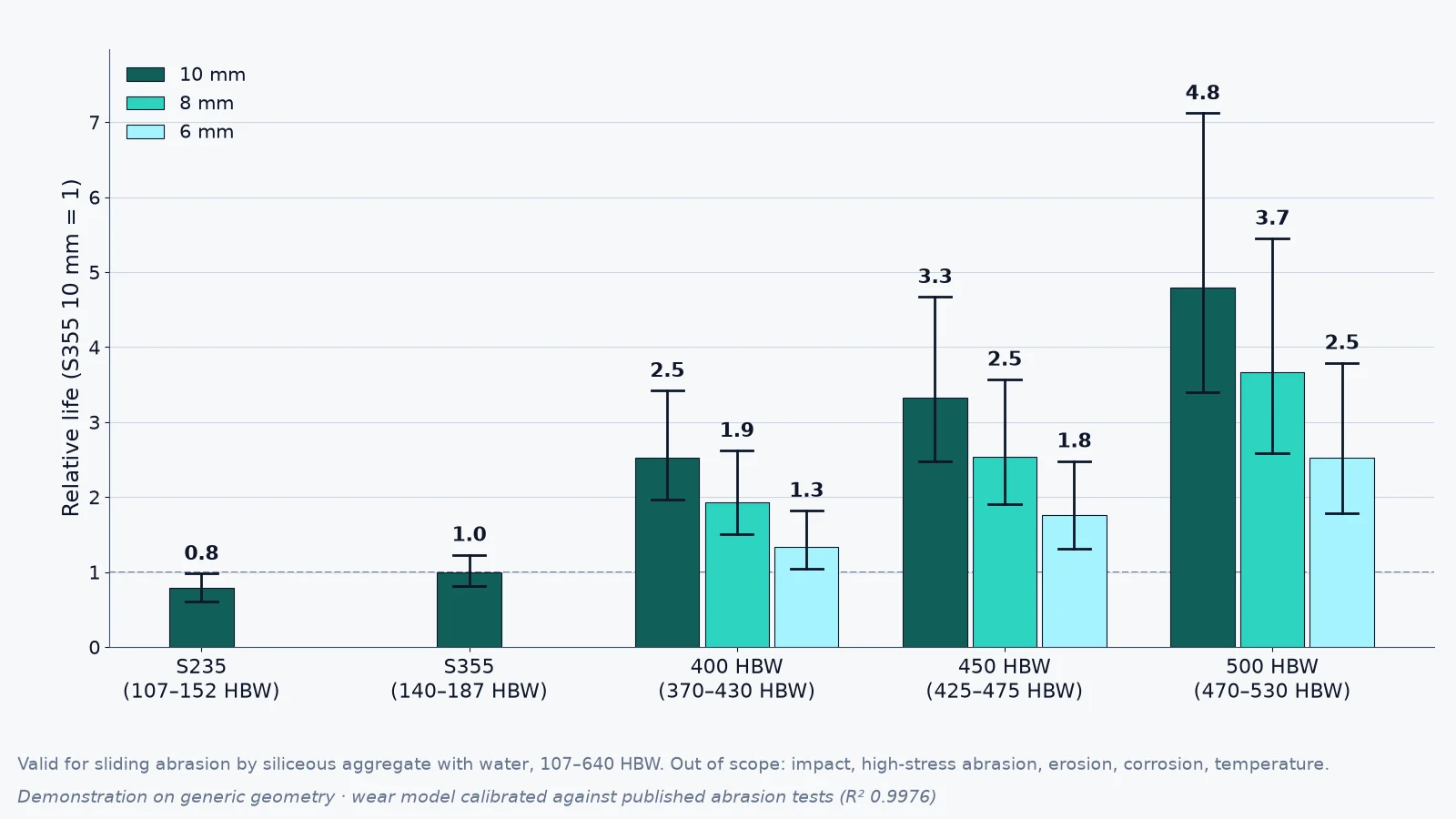
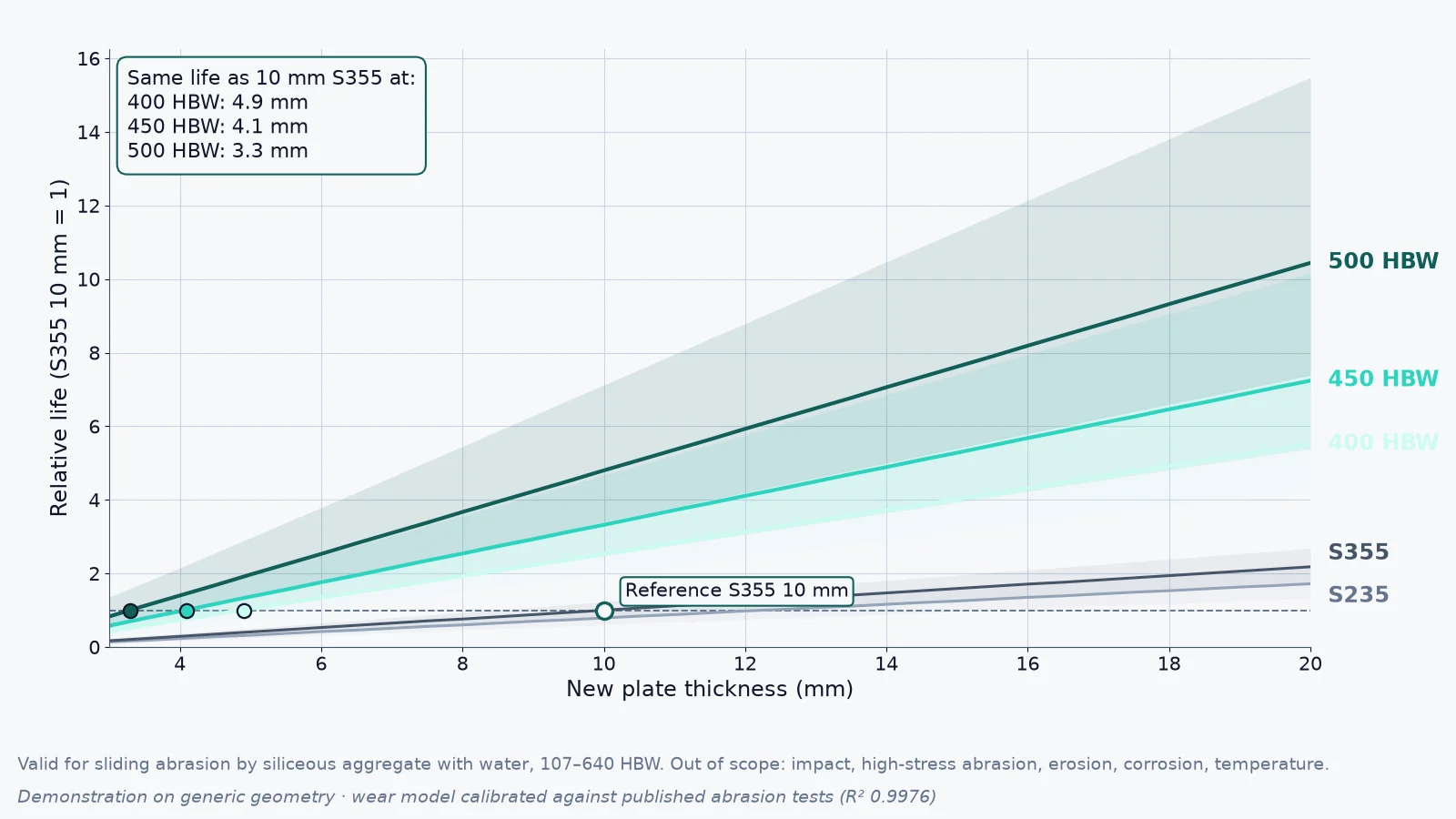
- R² 0.9976 in the fitted range; 4.8 % median deviation on a steel that was not in the fit.
- Result
- Relative plate life by hardness and thickness, in sliding aggregate abrasion.
- Limitations
- The model covers sliding abrasive wear. The minimum thickness is also set by strength, stiffness and impact, which this model does not calculate.
Model data sources
- Published testsWe calculate to: model fitted to published abrasion tests (R2 0.9976); 4.8 % deviation on a steel outside the fit
Our wear-plate supplier already gives us wear data sheets. What do you add?
Manufacturer data sheets compare steels under standardised test conditions. We calculate the life in your installation: your material, your thickness and your admissible residual thickness, with the uncertainty band of each comparison.
We do not have data on the material being transported.
We can start from aggregate specification data (particle size to EN 933, bulk density) that the client usually provides. No special material tests are required.
Does the wear model cover impact from sudden discharge?
The current model covers abrasive sliding wear. For failure by impact fatigue (crusher hoppers, tipper bodies receiving large rocks), a complementary finite element analysis is needed.
Can you calculate the wear of any abrasion-resistant steel?
The model is calibrated for the steels in the fit, from structural S235 and S355 to abrasion-resistant grades of 400 to 600 HBW. If you have your own steel test data, we can incorporate them into the model.
Propose a case
Describe your materials question in an email: the load of a bulk material, the fatigue of a weld, the wear of a plate or a clay blend. We will tell you whether it can become a case study and with which data.
Write to info@aixcresearch.com